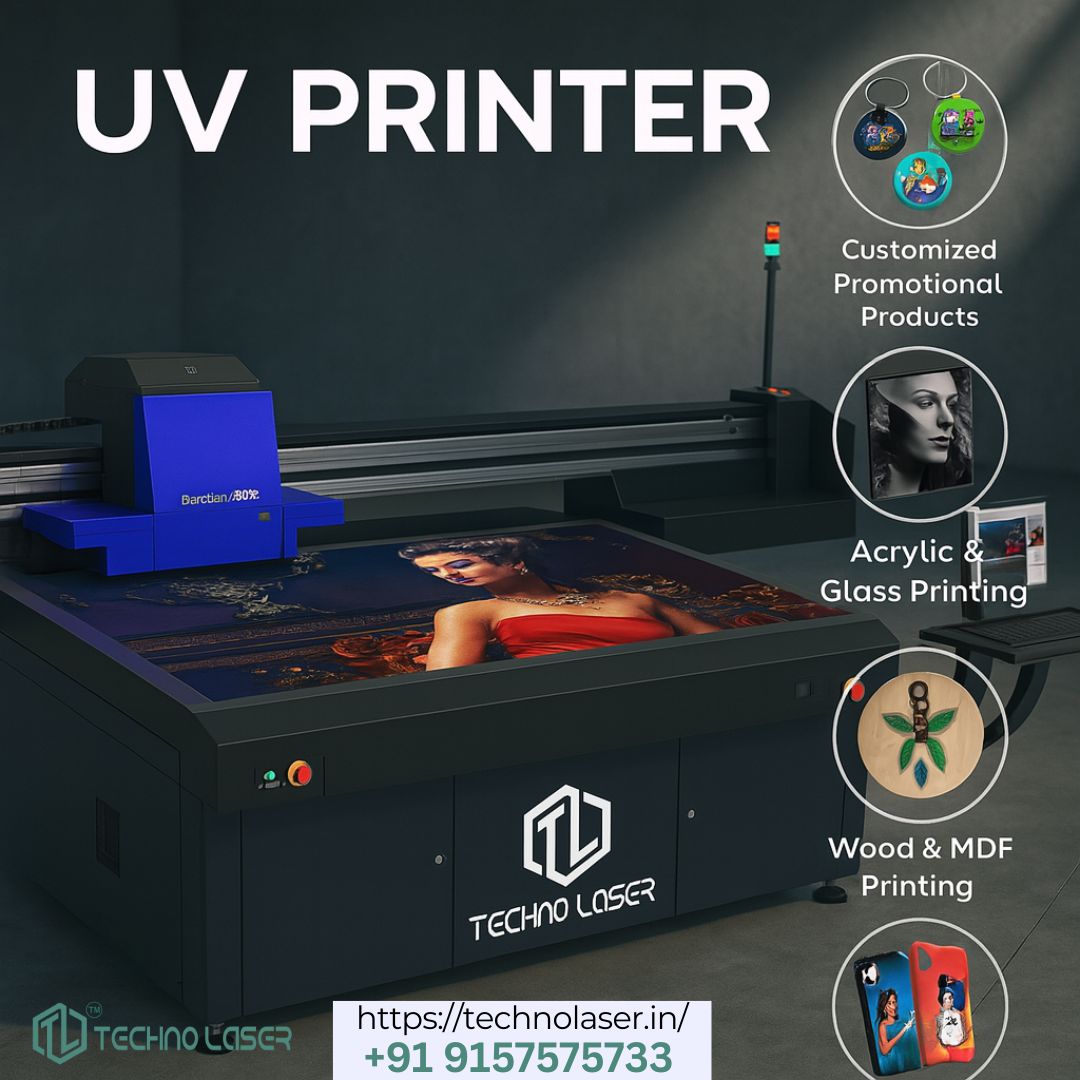
UV Laser Marking Machine Manufacturer
Introduction – UV Laser Marking Machine Manufacturer
Techno Laser is a trusted UV Laser Marking Machine manufacturer in India, headquartered in Ahmedabad, Gujarat. Our 355 nm UV systems deliver high-contrast, permanent “cold” marks on sensitive materials like plastics, glass, silicon, ceramics, and PCBs—without heat-affected zones. Built for precision, reliability, and low maintenance, our solutions support micro-text, logos, barcodes, and UDI codes for electronics, medical, automotive, jewellery, and packaging industries. With quick installation, operator training, and responsive after-sales support, Techno Laser helps Indian manufacturers achieve crisp, compliant, and production-ready markings at competitive costs.
Working Principle & Process Flow
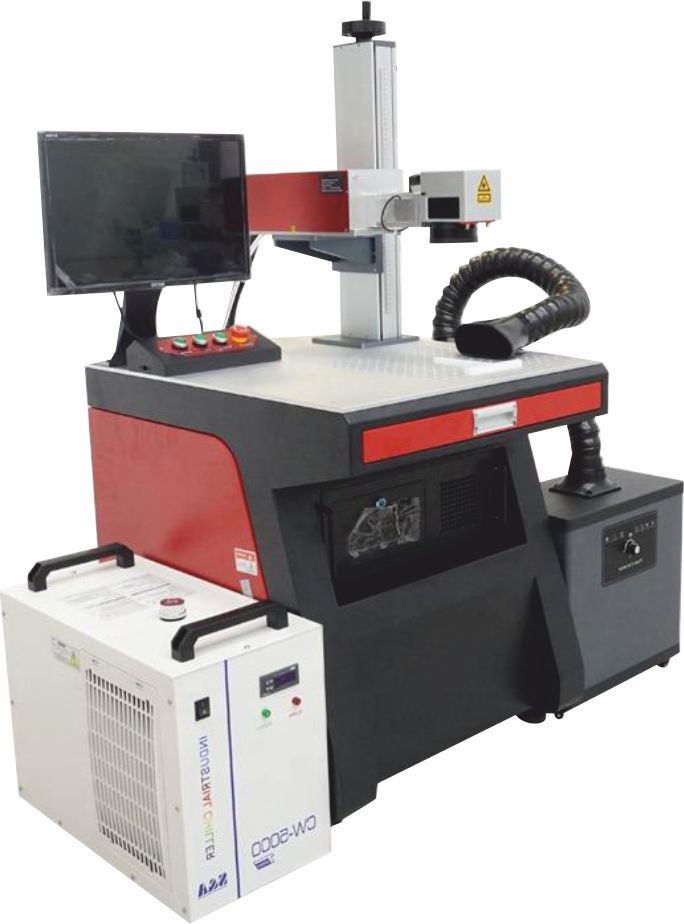
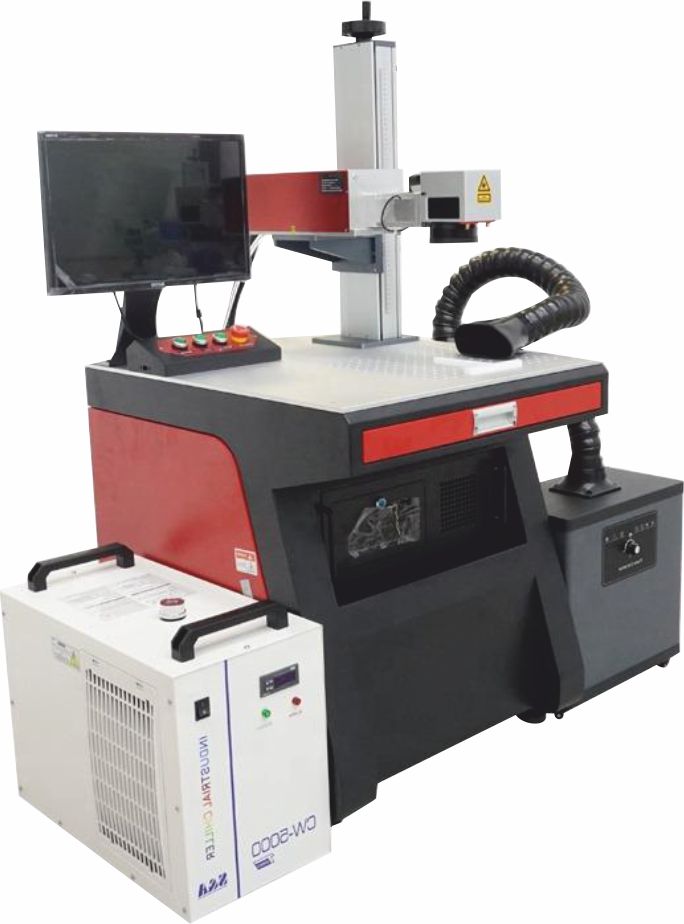
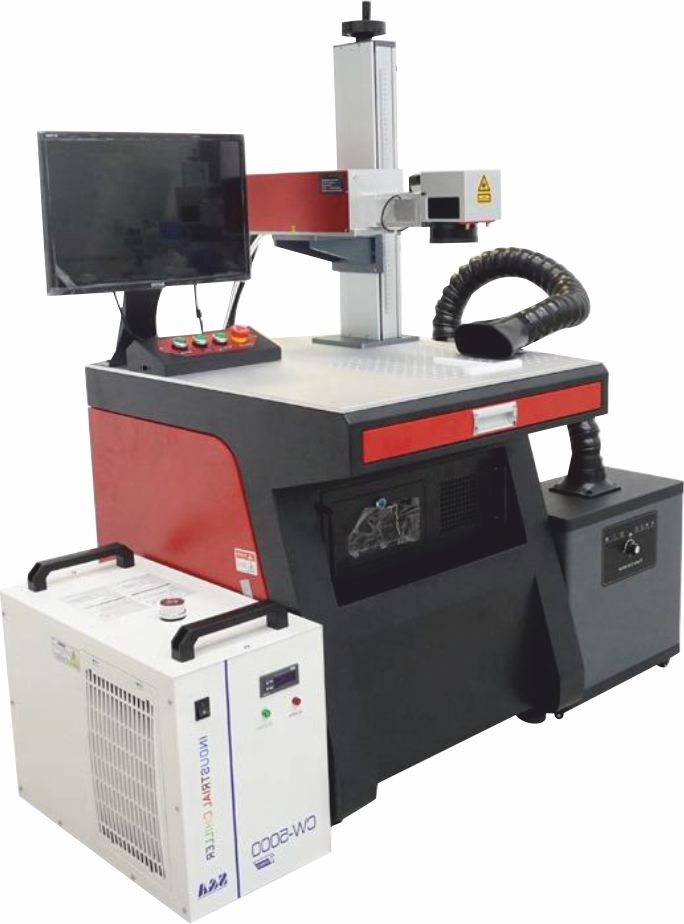
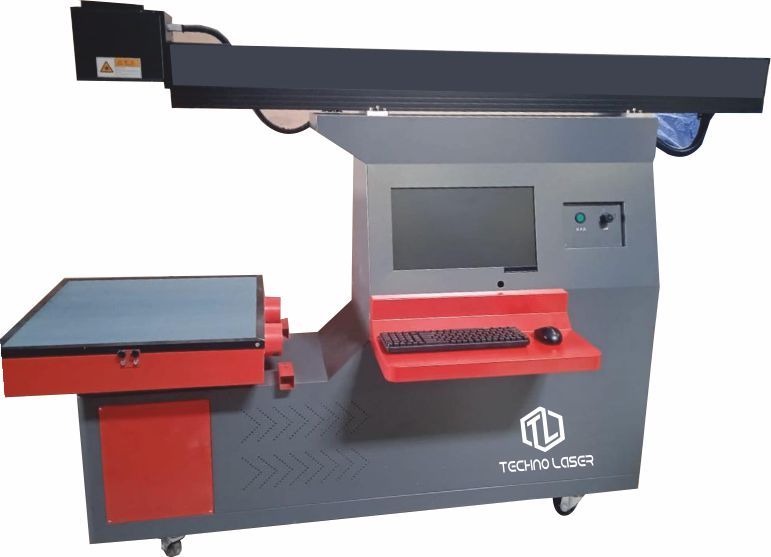
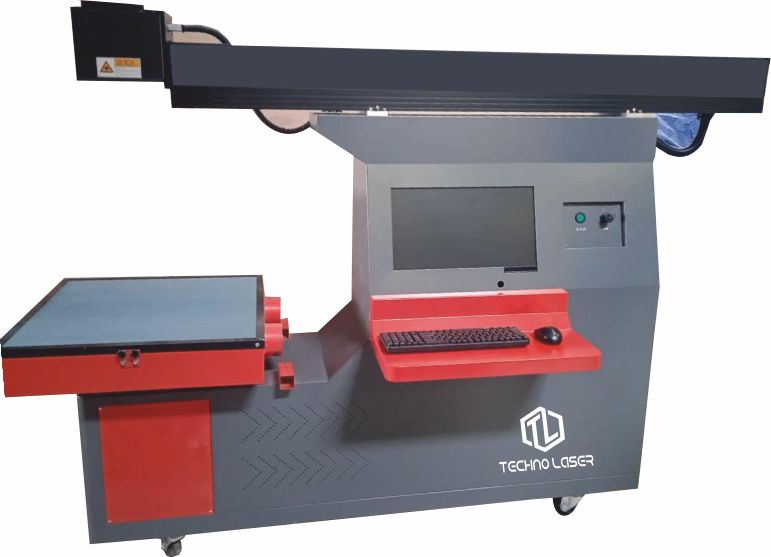
UV laser marking uses a short-wavelength (≈355 nm) DPSS laser to initiate photochemical ablation at the surface of the workpiece. The beam is steered by a high-speed galvo scanner and focused through an F-theta lens to achieve a tiny spot size, enabling ultra-fine features and sharp contrast. A prepared design (text/serials/2D code) is sent from PC software to the controller, which drives the galvo to trace the pattern at set power, frequency, and speed. Because the process is mostly photochemical rather than thermal, the mark is clean with minimal burrs, micro-cracks, or discoloration—ideal for heat-sensitive substrates such as ABS, HDPE, PVC, PET, nylon, epoxy resins, and coated/painted surfaces.
Applications & Benefits — UV Laser Marking
- Electronics: PCB legends, IC housings, connectors, micro-text & QR/DataMatrix
- Medical & Pharma: UDI on plastics, syringes, catheters, vials & blister packs
- Automotive: Wire jackets, switches, sensors, transparent & painted parts
- Consumer Goods: ABS housings, mobile accessories, cosmetic caps & pens
- Glass/Ceramics: Crisp logo/scale marking with minimal chipping or cracking
- “Cold” process—minimal thermal damage and superb edge definition
- High contrast on light/dark plastics, coated parts, and glass
- Ultra-fine spot size enables micro-text <0.5 mm and dense 2D codes
- Consumable-free, low operating cost, and clean process (no inks/solvents)
- Easy integration with conveyors, rotary fixtures, and vision verification
Key Features
- 355 nm DPSS UV laser with options typically in 3 W / 5 W / 10 W classes
- High-speed galvo scanner & F-theta lenses for 100×100 to 300×300 mm fields
- Tiny spot size (~10–20 µm) for micro-text, scales, and compact 2D codes
- Stable power with long service life; air- or water-cooled as per configuration
- Marking of plastics, glass, silicon, ceramics, anodized/coated metals & more
- Integrated dust/fume extraction interface; optional Class-1 safety enclosure
- PC software for serials, date/lot, logos, GS1-compliant barcodes & UDI
- Inline/rotary options, I/O for PLCs, and vision alignment (optional)
Where to Buy in India
For reliable UV Laser Marking Machines in India, connect with Techno Laser—an Ahmedabad-based manufacturer known for precision engineering, quick commissioning, and responsive support. From sample trials and application matching to on-site training and AMC, our team ensures smooth adoption on your shopfloor. Call us at +91 82000-09229 or email technolaser11@gmail.com to discuss your part material, marking area, and throughput—our experts will recommend the right power and lens configuration for consistent, high-contrast results.
Maintenance & Safety Tips
Monthly / Quarterly
- Clean protective lens, mirrors, and F-theta window with approved optics wipes.
- Check beam alignment & marking field calibration; verify code readability (QR/DM).
- Inspect cooling (air/water) and filters; maintain clean airflow around the cabinet.
Operating Best Practices
- Use UV-rated safety eyewear; operate with interlocks and enclosure closed.
- Select parameters (power/frequency/speed) per substrate; avoid over-exposure on clear plastics.
- Keep work surface dust-free; use fume extraction for clean optics and stable contrast.
FAQs — UV Laser Marking Machine Manufacturer
Q1 Which materials are best suited for UV laser marking?
Q2 How is UV different from fiber or CO2 lasers?
Q3 Can I mark tiny 2D codes and micro-text?
Q4 What marking areas are available?
Q5 Do you offer integration and after-sales support in India?
Get in Touch
Technolaser • We’re here to help
Relevant Tags
- uv laser marking machine manufacturer in india
- uv laser marking machine manufacturer in ahmedabad
- uv laser plastic marking machine
- uv micro text marking system
- uv laser glass marking machine
- uv laser udi marking for medical
- uv laser pcb marking machine
- uv laser for coated components
- uv dpss laser marking 3w 5w 10w
- uv laser marking machine price in india
- uv laser marking workstation
- uv laser marking machine near me
Related Keywords

Quick Enquiry

Our Products
Popular Links
Get In Touch
28,B-Gaikwad Industrial Estate, Near Polaris Industrial Estate, Bakrol-Indore Highway, Kuha Ahmedabad - 382433, Gujarat, India.
technolaser11@gmail.com
+91 8200009229
+91 9157575733
© Techno Laser. All Rights Reserved.
Designed by industrieslead.com